Thursday, September 30, 2010

The Mark Condor of the Outreach

A good view on a rest day
Gerhard dreaming of a rest day
For those not in the know, Mark Condor was a hero in the Sixties that made James Bond look like an under thirteen B rugby player. Well actually our hero’s name is Mark Cooper, but he is a lot like Mark Condor. Relentless, dedicated, adventurous, successful... In fact, he’s better than Mark Condor, he is Sooper Cooper!

DNA Strings as played by Sooper Cooper
No seriously, Mark is a hero when you look at him processing samples coming in. In fact, all these scientists are heroes when it comes to that. After a sunbaking, dehydrating hard day chasing bugs, sampling plants, catching reptiles, fishes and birds, you would expect these guys to arrive back at Klipbokkop, down a frosty or a softie, eat a plate of scrumptious Klipbokkop dinner and crash down. Zzzzzzzz...

Wrong. They get out of the Toyotas, each looking like a Father Christmas with their parcels and cooler boxes full of plants and crawlies. Then the hard work starts. Each specimen has to be physically numbered with a tag and catalogued on computer with matching numbers on the photographs and DNA specimens. And Mark is king of this castle.

Almost at any time of day and night, when he is not out in the field catching bugs, Mark is processing. The other night at around 9.30, he got up, looked around and spotted Michelle. Apologetically he asked to be excused, he was tired. The next morning around seven he resumed his task.


Sooper Cooper in action
Mark the marksman
Be that as it may, today was a rest day for the team. It was a breather to get ourselves ready because tomorrow we are on the road again towards Diepwalle in the Knysna forest. Il Doctoré Olive the Treeman is so excited he said he won’t be able to sleep. I suggested he should count sheep. “Are there sheep in the forest?” the Frenchman asked. OK, Olive count leaves.

But I am just as happy as Olive to go to the trees. He wants to hug them, and I want to... well, you know why dogs love trees. I wonder if Olive realizes hugging those Kalanders might not be so easy.  Maybe the whole team would be capable to hug the Big Tree near Diepwalle. We’ll try and get a picture of that.

The job ain't finished...
There is nothing more exciting than the anticipation of a new journey. “Hit the road, Jack”, some song goes. “Make a beeline for the trees, Gerhard,” I say.

See you in the shade.

Wednesday, September 29, 2010

Outreach team donates blood for DNA sampling

Elandsberg


Today was the day of Renosterveld. A day the team will never forget. Not only because they had the opportunity to offer their knowledge, skills and effort to help gather information that will help the most threatened habitat in the Cape Floral Kingdom survive, but also because they’ve been attacked. 

Just after nine we arrived at Elandsberg near Wellington. At 4000 ha in size it is the flagship piece of Renosterveld left. Quite scary if you think that Renosterveld used to stretch all the way from Vanrhynsdorp, down south to Tygerberg Hills and eastbound all the way to Mossel Bay. The dilemma is that the soil type and rainfall (250 – 600 mm) of Renosterveld is ideal for cultivating wheat and vineyards. For bread and wine. Essential stuff to fight hunger and keep the economy going. So the farmers are doing a good job, and they’re also coming to the party. They are aware that only 4% of Renosterveld is left and do an effort to conserve. Like Elizabeth Parker, the owner of Elandsberg that donated this piece of Renosterveld to remain unspoilt. Forever and a day. 


Luring a baboon spider from its hole

So the team hopped out of the Toyotas, ready to get going. Just before they dispersed, the enemy came. The attack began. Tabanus taeniatus descended in hoards, attacking from the air like Messerschmitts with silencers on. The common name for these gnats is horse fly, but I’m not so sure of the spelling. 

Snakeman at work
At one stage I was convinced that they were not real common Western Cape insects, but a strange kind of specimen from outer space that came on a mission to collect DNA from all these clever scientists. Look at it: they zoom in, zap you, zip your blood and zoot off to the mother ship. I tested my theory on Il Doctoré Olive, but he didn’t even smile; just turned around and kept on swatting flies. Then there was Snakeman handling a sand snake. It got aggressive and struck him on the finger. The next moment his face grimaced, but he did nothing about the snake. It was just hanging from his finger while he swatted a horse fly zapping him on the leg. Apparently the snake was harmless. 

Geometric tortoise
Be that as it may I have never seen sampling done at a jog. No wonder these guys brought back another 259 species, the highlight being a geometric tortoise, (Psammobates geometricus), one of the most endangered living creatures in South Africa today with just around 2 000 still left. 


This is not Buddy's water bowl
Later on I came across this lonesome yellow bowl standing in the middle of a huge patch of Renosterveld. It was heart warming. Shame, somebody thought of Buddy in this heat. Eagerly I approached, just to see the ‘water’ flooded with insects. Then Christian Deschodt, one of the insect gurus explained. It was a pollinating insect trap. The yellow bowl looks like a giant flower to them, so they charge in, just to plop into the propylene glycol in the bowl; a fluid that does not evaporate. I counted. At this stage 12 of the 259 species were in the bowl. These guys are good. Good, but tired tonight.

Therefore I bid you all a good night’s rest.


View the route we travelled today to Elandsberg: http://gpsed.com/track/5061178322052380339

Tuesday, September 28, 2010

Mission accomplished minus the one that just had to get away

Olivier & Michelle collecting plants
The target for the Toyota Enviro Outreach’s contribution this year was set at 1 500.  Two days ago we were standing on 1099. Since then the guys collected 405 species. That’s a total of  1 504. Mission accomplished! Finish and klaar.  Oh no, say the scientists. Oh no, say the rest of us, were only beginning. The interesting thing is that the total could have missed the magical 1 500. Or could have been one over it. Let me explain.


It all started this morning when we arrived at Kogelberg Biosphere Reserve. The scientists were aghast, looking at these endless mountains packed to the brim with Fynbos. To put it in perspective: The total area of the Cape Floral Kingdom is 90 000 km². Kogelberg alone offers   1 000 km² of that total. But listen to this: The Floral Kingdom boasts 9 600 species and Kogelberg Reserve has 1 650 of those. And our 17 scientists had free rein to do their thing. They were like school kids when the final bell goes announcing the summer holidays. Marsha our resident Russian was plucking her hair out again with excitement.   
The Palmiet River in Kogelberg
Gerhard our leader sent the fish guys down to the Palmiet River. Good choice. The insect team disappeared into the mountains. For once somebody was glad about the fire that burnt about 5 000 ha of the reserve down. It offered lots of easy rocks to turn for Snakeman. Or Geckoman, depending on what he gets. The birding crowd went onto Twitter... no, they found a birding spot on the banks of the river. 

After they dispersed, Gerhard took the plant people all the way back to the entrance of the reserve. The gang got out and started toy-toying. They didn’t know which Christmas present to open first. Then Michelle got a system going and they were pulling them in. Species after species. The only sad thing was that they knew there were not enough hours in the day to get them all. 

Fishing for compliments
A breather at Kogelberg


Catching a snake without Snakeman
Meanwhile Gerhard decided to look under the rocks in the burnt patch close to where the plant people were operating. Armed only with a few empty bottles, he started turning rocks, putting every one exactly back in its place. After rock number three he found it. A big bad looking black baboon spider. Lid unscrewed from his capture bottle in his right hand, he approached the monster, quickly whipping it in with the other hand, at the same time doing Rocky Horror’s Time Warp: It’s just a jump to the left... Thereafter the scorpion and skaapsteker snake was easy. Not to mention the two different species of earthworm. Five species in total. Without them, the total would have been one less than mission accomplished. 

A Southern Rock Agama
Cape Crag Lizard
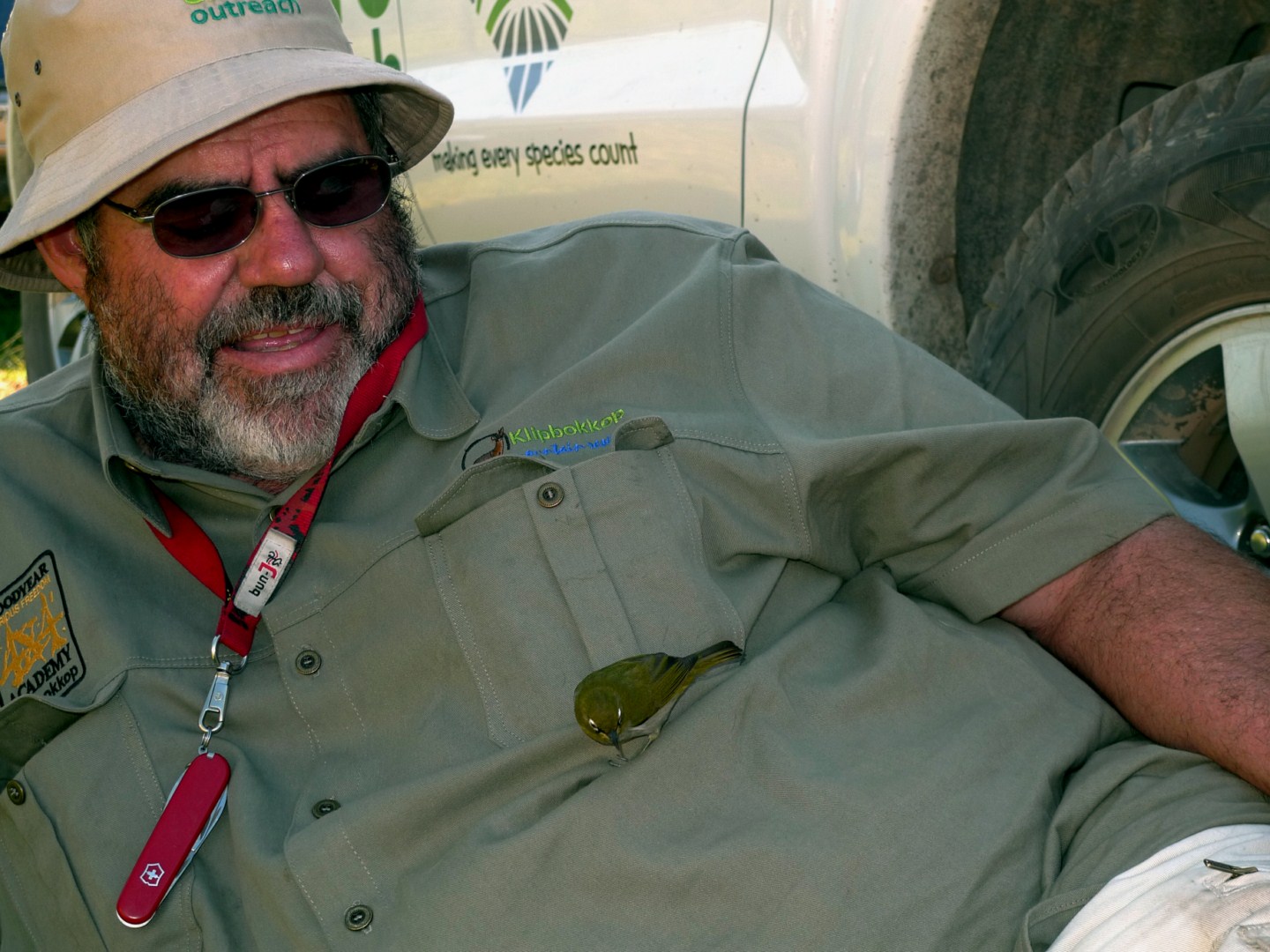
Later on in the afternoon, we drove to the house – still in the Reserve – of our hosts Mark and Amida Johns. Amida said that there was one special species – a Grubbia tomentosa – behind the house they just had to get.  We waited and waited and waited... apparently these plant people can’t count to one. Suddenly a Cape white-eye (Zosterop Virens) came to visit. First it perched on the fence next to us. Then it casually bounced off the fence and onto Gerhard’s chest. (Look at the pic if you don’t believe me).  Gerhard’s hand was six centimetres away. 
Gerhard and his Cape White-eye
“Shall I grab it for a DNA sample?” he asked.

Nobody said a word; the bird was just too beautiful. 

“No, just let it go,” Gerhard spoke all our minds. It flew away as our plant people came back. 

“Mark and Amida are so wonderful,” remarked Michelle in the car on our way back. “They even raised a small little orphaned Cape White-eye. It’s now their pet bird.”

Sometimes it’s good to talk about the one that got away.

We’ll talk again tomorrow...


To see the route we travelled to day, visit: http://gpsed.com/track/5061178321969011876

Monday, September 27, 2010

From a wolf to a leopard

At the top of Klipbokkop

While we went out today high into the mountains at Klipbokkop, I was thinking how a project like this changes your thinking. Just over a week ago, plants were plants, birds were birds and insects were insects. Most of the latter crawly funny little things than can annoy, irritate or even scare you.

Having been with the team of scientists for the last few days, however started altering your mind a bit. You see everything as life. You see everything as valuable. An important balance of ecology. An environment that has suffered from the pressures put on it by man. Then you look at this Outreach team getting out there, turning over rocks, chasing plants and all forms of life to try and restore this delicate environmental imbalance. And you wish everybody was like that.

Somebody that really is like that is Ester van der Westhuizen, naturalist, Groen-presenter and owner of Butterfly World near Stellenbosch. She said:

Wolf spider
Wolf Spider
“While the plant people have been doing there thing on the one side, the insect people and the spider person have quietly worked their backsides off to collect, identify and sample their noenoes. The insect people collected a whopping 732 goggos so far and the lone spider person managed 45 different spiders. All of the spiders have been photographed and boast fancy names like the wolf spider, baboon spider, lynx spider, but they are not that big anyway. To identify a spider properly you have to look at its eyes and not many people want to look deeply into a spider’s eyes. Almost everything is exciting and a great find, whether it is an old favourite or something new.

“The insect people said most of their insects are beetles such as toktokkies – one reason may be that the diversity of Fynbos plants needs a diverse lot of pollinators. Running neck to neck for second place in the insect numbers competition are the flies versus the ants and wasps – no clear second placer yet! But they are all so lovely...”

Ant Lion
Baboon spider
From the wolf spider to the Cape leopard. We had an interesting presentation by Jeannie Hayward and Anita Meyer from the Cape Leopard Trust tonight. The Trust started off in the Cederberg but is going from strength to strength and Jeannie and Anita is now running the Boland section of the Trust.

BM7 male leopard at Klipbokkop

BM3 male leopard at Klipbokkop
Klipbokkop is also involved and the Trust has four cameras on the resort. Today we went out to collect data from one of the cameras and we are privileged enough to post a picture of one of the leopards they caught in the limelight. Jeannie and Anita have now recorded 15 Cape leopards on camera of which nine are males. Traditionally a male has between two and three females in his harem which means that there can be anything around 30 leopards in the Limietberg area. Fortunately it looks like the Cape leopard might not follow the Cape lion. Visit http://www.capeleopard.org.za/ for more info.

Setting the motion camera
Tomorrow we’re off to Kogelberg Biosphere reserve for some serious Fynbos.

This is Buddy blogging off ‘til then.

Sunday, September 26, 2010

On any scientific Sunday

Another Sunday outing (Gerhard & Olivier)
On a Sunday morning sidewalk
Sunday fishing with Herman
Whiling away your day off


So breakfast was late this morning and we had the day off. To recharge the batteries, so to speak.  Well, the team of scientist welcomed the break. The chance to do what they love most. Yip, you’ve guessed it. They went out sampling.

Cape Galaxias
I don’t know whether it was because they had the day off and didn’t feel pressurised to perform or what, but they did exceptionally well. Not only did the accumulative total of all species for the day broke the previous record by coming in at 279 and bringing the total to 1098, the fish people also caught a Cape Galaxias. So what? you might say. What makes it so unique is the fact that there is only one genus in this one family and it contains only this one species in the whole of Africa. And we’ve got him! While they were at it, they also came across a marsh terrapin to keep Marius Burger fascinated on his day off. Marius, you can have it, this marsh thing stinks.

Marius and his marsh terrapin

Another thing that got me excited on this expedition is the Garmin GPS support we’ve got. Now as a well trained dog, I have never had the need for directional support, but on this trip the Garmins go much further than only finding your way. I’m not the expert so I asked Christof Linde, our on-board IT-guru to put you in the picture. While talking about Christof, I think he deserves a big hand for making this blog work and look so great. No matter where we are, the blog always gets on the internet. Sometimes via satellite and sometimes via smoke signals late at night, but it always gets there. Enough said, Christof, please explain:

“In the past the Toyota Enviro Outreach has only used Garmin GPS technology to plan the routes we will travel and also to track exactly where we have been since most of the areas we travel have no documented roads.

“This year however we are using technology called Geotagging. In short Geotagging saves the GPS coordinates on a photo automatically. With this year's Outreach thousands of samples are collected and with the Geotagging feature, the record keeping of these samples are much easier. The Geotagging further allows us to import all the photos onto a map and see where certain species are located throughout the country as well their density.

Geotagging example. (photo taken with Garmin Oregon 550)

“We currently use a Nikon camera connected to a Garmin Etrax GPS and also a Garmin Oregon 550 which has a built-in camera.”

Now that’s what you call the GPS of DNA and... what the... there goes Marius Burger like a bullet over the veranda fence here at Klipbokkop. He crashes in the rocks below. We all run to the edge, but he’s the only one over it. Lying face down in the rocks and spitting dassie dung, he holds his right hand triumphantly in the air. A little tail wiggles in his fist.

“Got him! It’s an Afrogecko,” he splutters.

OK, 280 species for the day and 1099 in total. But I’m going to sleep now, these guys never stop.

Saturday, September 25, 2010

The Hitchhiker’s guide to the Knersvlakte

The convoy on the Knersvlakte
Dudley and his fossils


Someone once said that travelling is a never-ending string of goodbyes. It surely felt like it this morning when we left Noup, saying goodbye to Dudley and Aletta Wessels, our hosts. They surely made Noup a pleasurable and successful scientific base.

Piratiny wreck
Like yesterday, on our way back from doing sampling Dudley took us on a slight detour to the coast to see the wreck of Piratiny, a 5000 ton Brazilian steamer that got wrecked there in June 1943. Later on after dinner he also showed us some incredible fossil samples from the area. The district is an 18 million year old paradise for palaeontologists as we could see from the ancient elephant molars and teeth from a monster shark called the Megalodon that makes a Great White look like the miniature klipvissies that Herman van der Bank and the fish team caught for sampling. The tooth in the picture attached is about 7 cm long.


Elephant molar fossil
Megalodon tooth
So as I’ve said, saying goodbye was rather sad, but it changed immediately when Gerhard offered me a ride in the new Hilux. Oops I’m not supposed to talk about it yet, so I’ll just whisper: The new Hilux is something special. It’s got a grand Buddy seat... Enough said. Rather watch the press for more information.


On our way back we suddenly turned off the N7 at Groot-Graafwater, about 40 kilometres from Vanrhynsdorp and headed straight into the Knersvlakte. We stopped in the middle of nowhere and everybody got out. What’s happening? I asked to no-one in particular.

“We’re here to check on the baby’s bottom and to pick up a hitchhiker,” answered Annelise, the expert on the Knersvlakte. She asked us to tread carefully on the pan of quarts pebbles we were standing on. Apparently it is teaming with life, but I saw nothing.

Bababoudjies

Then she stopped, bent over and there it was. A vygie called Argyroderma delaetii, but commonly known as bababoudjies. Look at the pic and you’ll see where the name comes from. Unless you’ve never seen a baby’s bottom or don’t understand the Afrikaans name. Although it looks like a baby’s bottom, the plant we’re looking at is about the size of half a matchbox, but can be anything between 25 – 50 years old and is endemic to the Knersvlakte.


The Hitchiker
Almost right next to it, she found the hitchhiker. Another vygie called Dactylopsis digitata or Duim-en-wysvinger in the local dialect. It looks exactly like someone hitching a ride and is also endemic to the area as is 155 other species. I immediately wanted to go and find them all, but unfortunately it was time for another goodbye.

So here we are, safely back at Klipbokkop but fortunately it is not yet time for another goodbye. Just goodnight until we blog again. But before I blog off, I saved the best for last: the score. Between yesterday and tomorrow and between Noup and Klipbokkop, they’ve added another cool 180 species rocketing the total to 819! Way over halfway after only the first stage. OK guys, breakfast tomorrow morning is delayed to nine o’ clock.

Goodnight!